Saturday, May 14, 2022

Eating Scrappy: Broccoli Stems

If you're like me, you likely eat just the florets from broccoli, using this most desirable part in your stir fries, veggie trays, and pasta primaveras. This leaves behind a good percentage of the broccoli, the stem. 

I've tried chopping up the stems to add to dishes, but without luck so far, as the stems can be quite woody, sort of like the ends of asparagus. 

When I came across a recipe literally called Broccoli Stalk Soup, I decided to give it one more try.

The first step is to prepare your stems, chopping off the very end, and peeling off the outer layer. A regular veggie peeler will do. Note: I wasn't aggressive enough with my peeling and still ended up with some woodiness. Go a little further than you think you need to, cutting off at least the outer 1/8".

Next, follow the recipe, sauteeing some onion and garlic in butter or oil (this whole recipe can be vegan if you prefer), then adding the broccoli, some potato, and broth to simmer.

Finally, use an immersion blender to puree all the ingredients. My soup was quite hearty (more of a porridge), so I added 25% more broth. 

This soup has great flavor and an unexpected creaminess (with no actual cream), which comes from the potato. And it's quite light,  so feel free to add to it as you like. Add in some broccoli florets if you have whole broccoli, and some medium or sharp cheddar for a rich, cheesy soup. 

Now, I noted above that I wasn't aggressive enough with my peeling. If this happens to you and you taste your soup and get little woody bits (no one wants to chew on pine needles), never fear. Strain your soup through a mesh strainer.

Woody bits successfully strained, and silky smooth soup rescued!

What are ways you've found to maximize you use of veggies?

Sunday, May 8, 2022

Healthy Feet, Healthy Planet

Buy Nothing delivers yet again! With many companies having 30 day return policies, if you aren't on top of it, you may be stuck with an item that doesn't work out for you. In my case, one shopper's loss was definitely my gain. They had purchased these awesome Taos sandals (for $125), and while labeled a size 10, they ran a full size small. Never worn, except to try them on, these premium support sandals are now mine for free! Taos are known for their support and comfort - just check out that molded footbed and arch support.


I love the fuller coverage of these sandals too, which give much more structure than a flip flop, and these just may be my go-to shoe heading into summer. Of course, now that we're heading into summer, you should pair those new sandals with a fresh pedicure (this polish is called "Sangria").

 
While working on that pedicure, consider incorporating Ella+Mila products. Ella+Mila prides themselves on being eco-friendly, vegan, cruelty free, and 17 chemical free (chemicals dangerous to humans). The first item I've purchased from them is their Soy Polish Remover, which I've found is just as effective as acetone and is both conditioning to my nails and has a soft pleasant scent.


Overall savings: $125, and I'm thrilled my feet are ready for summer!


Sunday, May 1, 2022

Mini-post: Return to Reusables

One of the things that's made me sad during the pandemic (besides all the... pandemic) has been the increase in disposables and single use items. I was originally optimistic about the potential eco silver linings with people staying at home, not commuting to work. Remember those early pictures of smog reduction in the cities? But then, just a couple months into it, we all started going out a bit, and the gains in smog returned to normal, and we swung far into the other direction. We could drive through and takeout from restaurants, which meant tons of disposable packaging, and so many people wore (and littered) single use masks. 

Now that we are able to go back inside restaurants, and with new laws like Washington state's single use serviceware law (to not automatically include plastic utensils, straws, etc), now is a great time to double down on reusables. 

Consider bringing your own durable straws and utensils to casual restaurants, and your reusable mugs to coffee houses. Consider bringing a small takeout container in your purse or backpack for your leftovers. 

As an incentive, many coffee houses who had to pause allowing customers to bring their own mugs during the height of COVID, have now resumed their programs, many times including a small discount. Starbucks, who previously offered a $0.10 discount, is now doubling their rewards. You get both the $0.10 discount, as well as 25 stars if you're a rewards member. 

They just announced this on Earth Day. It's currently only available in-store, but they taken goals to make bringing your own cup an option for drive through and mobile by 2023. 

Not a Starbucks fan? Check out incentives programs from your favorite coffee shop or restaurant for bringing your own reusables.

Sunday, April 24, 2022

From Scraps to Soup

If you haven't spent a lot of time in the seafood aisle of the grocery store, there are a few ways to buy shrimp: whole (you may need to remove head and vein), EZ Peel (head and vein removed), or fully peeled and tail removed. The less prepared they are, the cheaper they are, but the more work for you. I love the EZ Peel as a good middle ground. In order to remove the vein, they slice the shell the whole length of the shrimp, giving you a super easy place to start peeling (hence, EZ Peel). This leaves minimal effort to prep the shrimp and can save you $1-2/pound.


Not only do you save a few bucks, but now you have this resource which is rich in minerals and vitamins as well as flavor. Take the shells (legs, tails, and all) and put them in a container in your freezer to accumulate and not have your fridge smell fishy until you are ready to use.

 
Now it's time to use up those shells. (Note: you're about to stink up your kitchen, so open a window!) I'm combining a few recipes for corn broth and shrimp stock, including one that used both for a chowder base. In addition to shrimp shells (from 1lb shrimp), I saved 6 half corn cobs and shells from 2 leg sections of snow crabs. 
 

Dump those, and enough water to cover, in a large soup pot. I love these large Pyrex measuring cups for if you want more precision. One of the recipes called for 9 cups of water, and since I was using a lot of base ingredients, I upped that to 12.


Next add, some veggies, onion and celery for depth of flavor. You can use scraps for these too. Most veggie broth recipes call for using onion skins and the tops you would generally cut off. Your celery can 100% be a wilted stalk, a great way to clean out the fridge. (Side note: wilted celery can also be revived but storing in cold water. The wilting is due to water loss, and it will perk back up.)


Add all of this to the soup pot, along with a couple bay leaves and some whole peppercorns. Bring to a boil, reduce to low, cover and simmer for 1 hour.


It's that easy! Strain out all the solids (now you can compost those), and once it's cooled, portion and freeze what you won't use within a few days. I was super pleased after a taste test that this broth had a rich flavor with none of the bitterness I experienced with my first attempts at veggie broth.

Now what to do with this super flavorful broth? Keep in mind that both seafood and corn are a bit sweet, so while you can use this anywhere you would normally use broth, it will work better for things that can tolerate some sweetness. 

For both corn broth, shrimp broth, or combo like I made, it was recommended to use a base for soups or chowders.
 
For straight corn broth, it was suggested to make grits. 

I'm foreseeing some decadent risotto in my near future!

Thursday, April 14, 2022

Secondhand Steals and Conscious Comfort

Sometimes you hit the secondhand jackpot. This thrifted and gifted outfit was the perfect trifecta: a) new with tags or like new, b) brand name/high value pieces, and c) super soft comfort. 

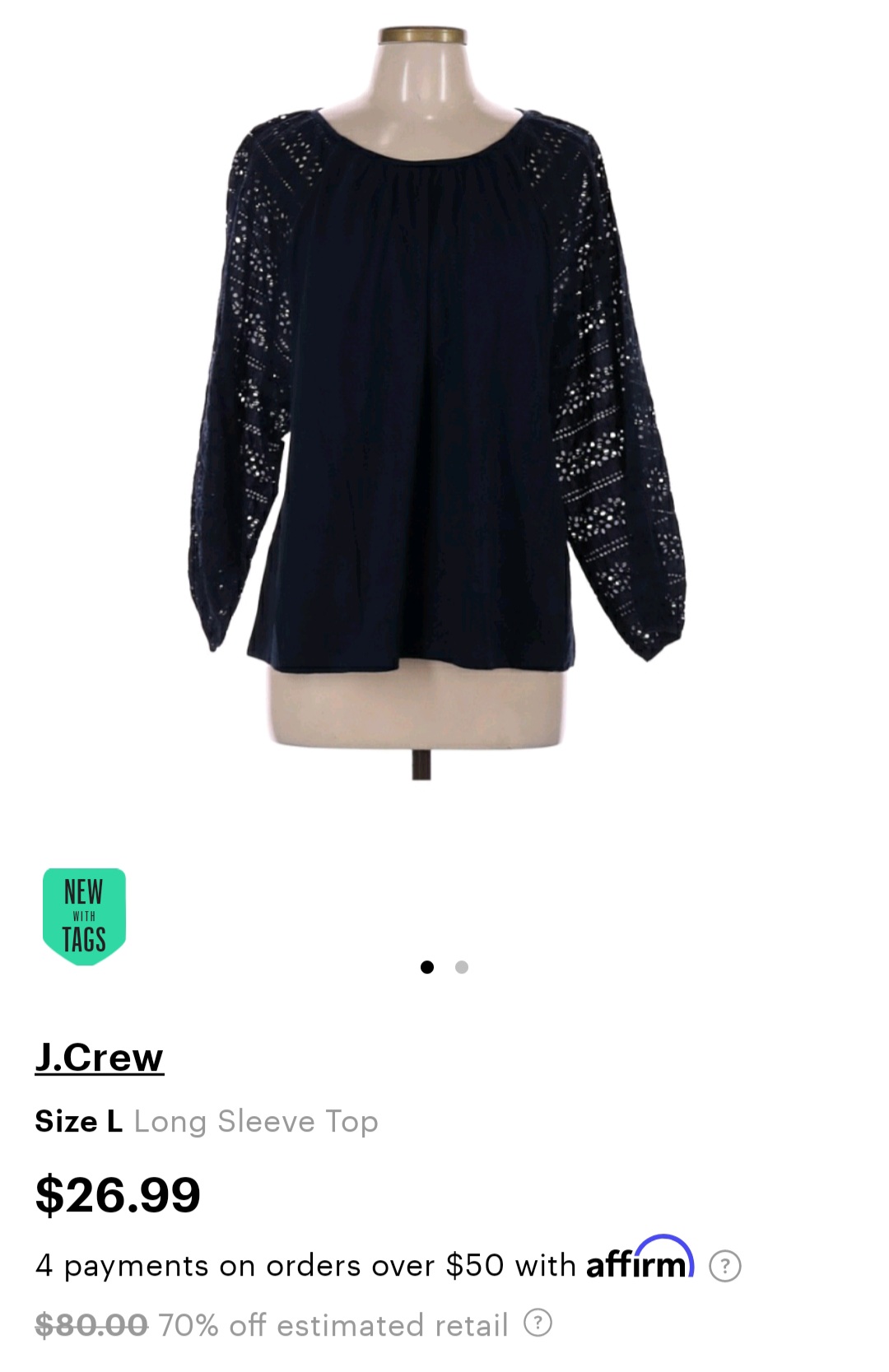
With this blouse, I love the voluminous airy sleeves and eyelet lace. The body is a heavyweight but very soft jersey knit. It feels like wearing pajamas, but the embellished sleeves and ruched neckline give it it a more polished look than your standard tee.  


This J. Crew blouse was new with tags from ThredUp, and was just $26.99 (vs $80 retail, a 70% savings).

I paired the blouse with a pair with Mugsy jeans. These had no tags but were like-new quality. These were free from Buy Nothing, and retail at a $108 value. Just like the blouse, these jeans are ultimate work-from-home cozy, but work-from-office cute. Even from the Mugsy website, they pride themselves on comfort: "With super stretch, breathability & cloud like softness, our high-tech Mugsy Denim is so comfortable you'll feel like you're wearing sweatpants."


I've always been nervous to wear navy tops. You aren't supposed to wear navy with black, but then you pair with jeans and you're all blue... we'll the good news about a monochrome base is you are then free to accessorize with bold prints and patterns. Add a dramatic floral scarf or a bright handbag. We ease into it here with a green striped belt. 


Between the blouse and jeans, this outfit cost $27 (an 84% savings off of $188 retail price). 

Going to work in total comfort? Winning!


Sunday, April 10, 2022

Empty Your Trash for Earth Month

It's time for an AUDIT!

OK, I know that word is scary during tax season, but it's also Earth Month. 

So this month, we're going to do a *trash* audit. 

Sometimes, you can make all these changes... reusable mug, reusable food storage, swapping dryer sheets for wool balls... and after all of that you don't know if you've made any impact. And if you're comparing yourself to the super zero-wasters whose trash fits in a single jar, you may start to get overwhelmed that it seems like an impossible task to reduce or eliminate your trash. Well, in order to know if you're making an impact, you need to know where you're starting from. 

A few years ago, I started collecting my recyclable plastics for an upcycling project. I assumed that the majority of my plastic waste was going to be the white plastic lids from Starbucks hot beverages, and after several months, I learned how wrong that was. Now, the first two types of plastic waste I made were indeed coffee-related :) but it was mostly my creamer bottles from home-prepared coffee. Point being, the areas of waste you think you have may not be the biggest opportunities in reality. 

First step: pick your full trash bin or recycle bin, and literally dump it out. You may want to prep first by bringing it outside and/or laying down a tarp! You may also want a pair of gloves. :) 

Next, start sorting the waste into categories. Is it leftover food, plastic, aluminum, vacuum lint, paper bills?

(photo from Brian Hoffman, Flickr, Creative Commons license)

Next, start dividing into subcategories. Is there a single source within a category? For example, my plastic waste was almost entirely creamer bottles, followed by dairy containers (ex. sour cream tubs). 

Identify your top 2-5 sources of waste.

Now what to do with this information? 

1) Stop worrying about everything not in those top 2-5 sources. Look at the pile outside those categories, is it less than 20% of your waste? You can make dozens of changes and not realize any major results if you focus on the the wrong ones. 

2) Make a plan for the top sources. I had you identify 2-5 for a couple reasons. Not only will these make up the majority of your trash can and be the most rewarding to resolve, but also, you can move on to the #2 or #3 item if the first one is hard for you to address. There may be items that you just need to cut yourself some slack on because you really love that thing or your life requires some convenience. 

To start making a plan, look to the R's, and in this order: 

  • Refuse/Reduce: Can you live without the thing altogether? Is there an alternative that creates less waste or packaging? For example, if you have a lot of beverage cans in your trash, are you able to switch to a tank system like SodaStream? If it's paper bills, can you switch to e-billing? Can you unsubscribe from junk mail or catalogs?
  • Repair: Is the item something that could be restored? If you are throwing away clothes or shoes, could they be fixed with some simple sewing or shoe polish? Or a visit to a tailor or cobbler? 
  • Reuse/Gift: Are the items something that can be repurposed? For example, if you are throwing away containers from lunch meats or takeout, they are equivalent to Gladware or similar food storage. If you have acquired too many to reuse yourself, have you posted to gift to a neighbor?
  • Rot: Synonymous with composting. Is the majority of your trash food scraps or leftovers? You don't have to have a home composting system for this, as some municipalities let you put your food scraps right in with your lawn and garden waste. If you are worried about smells or pests or leaky countertop bins, simply put your food scraps in a bag in the freezer. When the bag gets full, transfer it to your yard waste bin. The freezer will solidify any liquids and reduce the time it's in your bin. 
  • Recycle: I'll include trash and donate in this category. These are your last resort. Unless you have a charity or organization calling for specific types of donations, your thrift store drop-off may very well end up ultimately in the trash. 

After you've identified your top categories, chosen from those the ones you're most able and willing to address, and reviewed the questions above, you should end up with something like: "Wow, food waste makes up 30% of my trash. I'm going to Reduce by sharing meals when eating out and making a planned grocery list for when eating at home. I'm going to Reuse by intentionally eating my leftovers and using up leftover ingredients in the same week. And I will Rot the rest." 

Now you can save mental effort by focusing on one or two changes and having confidence you've made a substantial impact!

Sunday, April 3, 2022

Public Transit for a Better Vacation

T and I just got back from a week's vacation in San Antonio, TX, where we got some much needed rest and sun. 

We've got a pattern going where our first day in a new place we get on one of those hop-on hop-off tour busses. It allows us to get the lay of the land, get a little bit of narration, and get transportation to one or more of the notable spots. While it could be a bit too "touristy" for some folks, we've found it fairly economical, and a good way to get oriented with the major highlights.

After the first day, however, we tend to strike out more on our own. At one of the shops we stopped at, the store owner told us about a special bus route, called the "culture line", which would take us by a lot of the major attractions such as the art museum and botanical gardens. So we hop on the Via (San Antonio's bus service) website, only to discover that the specialty lines have been paused since COVID, but that the standard city busses will work well for us.

I was super impressed with the modern tech for navigating ticketing and the routes. They have an easy app to purchase and store your ticket, and you simply show the QR code to the driver to ride. For trip planning, you have a bunch of choices: 1) there's another app, 2) they are fully integrated with Google maps, 3) from any bus stop, you can text the bus stop number and get back a list of all the busses and their next 2 arrival times. 

We chose the weekly option, and at $12 each, it paid for itself on the first day. We headed to the botonical gardens, which would have been $12 + tip each way if we used Uber. (And this was our reward, for the short 8 minute walk from the bus stop to the gardens.)

We did similar trips throughout the week to restaurants or attractions, saving a total of about $96 vs Uber (and twice that vs Lyft). Take all those savings and do an extra river boat ride and order dessert every night!

Other benefits, of course, are vs cars, you are making the more eco-friendly option. Vs walking, you get a break for your feet and get to expand your radius of exploration. And finally, you tend to take more local streets vs highways and get to see more of the town. There were at least a few sights and restaurants we discovered because of travelling a different route or being dropped off on the opposite side of our destination.