Showing posts with label compost. Show all posts

Sunday, July 24, 2022

Spotlight: Taco Time NW

I nerd out a bit about Taco Time NW. Sure, it was my first summer job in high school, but also, the "sour cream" on their soft tacos is ranch dip, so what's not to love?

However, what's really cool about Taco Time is they have cared about their ingredients and packaging long before there was a plastic straw ban or "ask first before handing out consumables" law in Seattle. 

Taco Time proudly sources their ingredients from local suppliers. As a local, family-owned company themselves, they understand that sourcing from local suppliers means supporting the local economy as well as reducing fuel and costs to transport those ingredients.

Next... EVERY ITEM of packaging in their store is 100% compostable (except for ketchup packets). Long story short, back in 2010, they understood that the area was going in the direction of fully recyclable or compostable for food containers, and after testing some options, realized it's hard for customers to sort their trash, and much of the recyclables were contaminated, etc. Not only do we know you can't recycle your way out of plastic waste, but choosing 100% compostable was easier on customers and with better results (ie not losing out on contaminated recycling). Taco Time NW has now been a leader with compostable serviceware for several years. If you'd like to learn more about their process to get there, read this. 

While I've noticed the compostable serviceware for some years now, this new sign caught my eye on my last visit.Taco Time NW has 2 new sustainability initiatives: 1) Match their electrical consumption with investments in renewable energy, and 2) Make their restaurants carbon neutral through partnerships with forest projects. To learn more and not read this tiny picture, visit their page here.

So next time you are craving a fast-food taco, consider visiting one of the 79 restaurants in the PNW. You can eat guilt-free with a sustainability leader in the industry. Maybe just a bit of guilt though for asking for an extra side of ranch!


Tuesday, December 29, 2020

Twelve Days of Conscious Christmas: Day 12, Recycle Your Christmas Tree

It's getting to be that time where you're thinking of taking down your Christmas tree (I do plan on keeping our lights up though January!). If you have a real tree, there are some considerations for disposing of it: 

  • Check your local yard waste guidelines. In King County, WA you can only put branches less than 4" in diameter in your curbside bin. Many tree trunks will exceed this. If you have a slender tree, simply chop it us and put it in your regular curbside yard waste pickup. 


  • Give your tree new life as wood chips. Check this flier for free or discounted disposal at various events and transfer stations.
  • If you have room, let it decompose naturally in your yard. "The tree branches and trunk can provide habitat, shelter wildflowers, hold moisture and help build the soil, mimicking what happens with dead trees and branches in a forest." More information from the Nature Conservancy of Canada here. 
  • If you have a fireplace or firepit, use it as firewood. You need to let it dry out first, so you may be prepping it for summer campfires or next winter's fireplace. 
  • Support a local scouting group, who make be offering tree disposal as a service and fundraiser. This is the flier for Burien and surrounding areas. 
 
 This concludes our 12 Days of Conscious Christmas. I hope you all had a delightful holiday season!


Sunday, November 18, 2018

Food for Thought

As the world population grows and with it, the waste reduction movement becomes more mainstream, we're starting to see TV programming join in. Here are a couple shows to check out to give you some great ideas about minimizing food waste:

1. Wasted! The Story of Food Waste (85 minutes documentary). This film was produced by Anthony Bourdain (RIP) and was organized around two simple ideas. First, there are billions of pounds of food wasted each year and there are billions of people that are food insecure. Seems like a 1:1 problem that we can solve. Second, the EPA has a pyramid for ways to utilize food. The film follows each step of the pyramid to look into areas where waste is created (from farms and fishing operations, to restaurants and grocery stores, to end consumers) and solutions for each (from big to small).


(source: www.epa.gov)

I haven't found Wasted! for free yet, but it is available for rental as low as $1.99 through Amazon Prime Video or a number of other apps referenced on their site. You can also request a community screening; I learned about this through a community screening at my work.

2) Scraps (series on A&E, now in season 2). Chef Joel Gamoran goes around the US making incredible meals out of parts of food that would otherwise be discarded. I learned about this show first through my mom (Thanks, Mom!) and then was lucky enough to have Joel be a guest speaker at work. He spoke about things that we often don't think to eat that make great dishes and often become mainstream (think: using carrot greens for pesto). You can take classes at a Sur La Table near you on the theme, for example, how to re-purpose Thanksgiving leftovers. He also has a cookbook, Cooking Scrappy, for more inspo.

Next steps:

  • Check out these shows for inspo! (And let me know if you find others. :) )
  • Think about how you can insert a step in your own life before compost or the trash. Can you you use the heels of your bread loaves to make homemade bread crumb? If you have a recipe that asks the the whites of green onions, can you meal plan to use the greens? 
Happy Scrapping!

Thursday, November 17, 2016

What's wrong with this spoon?

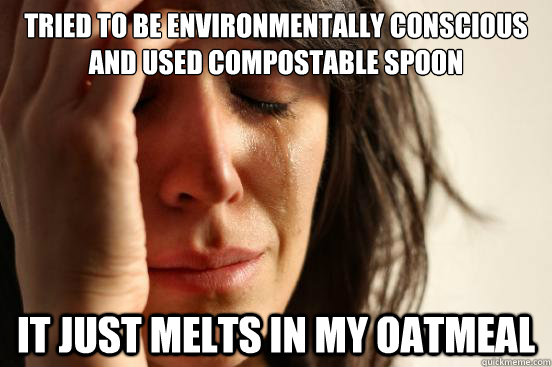
If your office is of any decent size, they have likely made the switch to compostable disposable utensils. How can you tell? Well, besides the color being beige or brown instead of black or white, really how we all know is when your "plastic" spoon looks like the clocks in a Salvador Dali painting after you stir your soup.


Now that we've identified we have compostable flatware, we need to make the fragility worth it. Most compostable kitchen products need to go through a commercial composting process. If they're thrown in the regular trash, you may as well have used a regular plastic spoon, as they won't break down much quicker than plastic in the landfill.

So, here comes my lazy girl problem: I'm not going to walk to the kitchen to grab a utensil, bring it back to my desk to eat, then walk back to the kitchen to sort my trash. Not when there's a garbage can right under my desk.


Enter: any paper shopping bag. I simply dump my forks and spoons in there after lunch. Then periodically, I can bring it with me to the kitchen and empty it. If the bag gets soiled, or I'm not heading back to my desk, it can get composted too. 

Effort level? Minimal.