Showing posts with label repair. Show all posts

Saturday, November 12, 2022

Kintsugi - The Golden Repair

Kintsugi is a Japanese method of repair, typically for pottery, where you fill chips, cracks, or even rejoin full breaks with gold. Not only does this allow the piece to be in service for years to come, but rather than trying to hide the repair, it is highlighted and celebrated as a part of the history of the piece. Here is an example:

The Japanese have multiple methods of visible mending in their culture; in addition to kintsugi for pottery, they also have sashiko (embroidery) and boro (patching) for textiles. I love this concept to extend the life of my items, while adding character and color. 

Having learned about kintsugi years ago, I was just waiting for an opportunity to try it out myself. Despite my reputation for klutziness, I surprisingly break few dishes! However, I do have a large wooden salad bowl that has a crack through the side of it. It's a fairly small crack that will be easy to experiment with. The offender:

I'm starting with a food-safe silicone. You can choose a product that matches the material you're working with. There are plenty of choices out there, from silicones to epoxies to resins. Just make sure if you're working on dishes that you choose something labeled as food-safe, and that you work in a good space. Most of these products will have an odor and require ventilation. If you're working on something that is just decorative, you could even use a nail polish.

Next, you'll need pigments. I had these leftover from previous craft projects - you should be able to get them where you get your medium. I have a few different shades of gold, so I'm mixing a shade.

I mix the pigments with the silicone, and then apply to the crack with a small paintbrush. This crack goes all the way through the bowl, so I work from both the inside and outside to make sure it's entirely filled. Remove any extra that lands on the surface of the bowl with a clean paper towel.

Here's how the outside now looks:

And the inside:

Now it looks more like a scratch, and when it hits the light right, you can see the gold. The main benefit here is that now I don't need to worry about food or moisture getting inside there and damaging the bowl more, or being hard to get clean.

What are some of your favorite methods for visible mending?


Sunday, March 21, 2021

Extend the Life of Your Footwear

I have a perfect pair of black heeled booties. They are the right height (a medium heel) for wearing with pants or dresses, have a classic black leather look, with stylish gold zipper and buckles. 

But the most important thing? They are comfortable. The arch is just the right height, to not put pressure on my feet after a a full day's wear, and the toe box is wide enough. 

Needless to say, they've gotten a ton of wear and were starting to show it. And I fell into a super common trap: "They weren't super expensive. I don't think they're worth the cost of repair." Fortunately, my friend Julie changed my mind. Not only is repair cheaper than buying new, and the sustainable choice, but her argument? "How often do you find a pair dress shoes that is actually comfortable?"

So I found myself a shoe repair shop, a small one-man shop named Vic's in Burien, and requested a few areas be improved. First, the toes, which were both scuffed and a little stained from the rain. Here is the after - he did a pretty nice job with polishing!

I neglected to take "before" pictures, but this is a pretty good representation of the level of discoloring. 

Next, the heels had two big issues. The leather on the heel was pushed up, exposing the white core, and the heel tip was unevenly worn. Vic fully replaced the tip and smoothed and glued down the heel wrap.

Again, not my "before" photo, but this shows a similar type of heel wrap peeling I was facing.


Overall, I was pretty pleased with the repairs. I paid $22, and probably could have invested a little more to fully replace the heel wrap. These Sam Edelman booties cost around $60 originally, meaning I can repair them 3 times before it would financially make sense to replace them, and more if they continue to be comfortable and supportive to my feet.

Thanks to Julie for reminding me about my priorities and saving my favorite booties!

In this era of fast fashion, what are some items that you've forgotten you can repair yourself or get repaired at a low cost?

Saturday, May 16, 2020

Secure Those Slipping Shoes

I got these cute flats off of Buy Nothing a while ago. I love the scalloped front edge detail, and they're generally really comfy. Except, with the first step, it was immediately evident I couldn't wear them all this. There wasn't just a little slippage - my full ankle came out with every step. I just knew that I would spend more time trying to keep these on by gripping my toes than would be worth it, so I needed to find a way to secure them or move on.


A couple You Tube tutorials later (Example 1, Example 2), and I had my method planned; I would add an ankle strap. You can do this to secure loose shoes, or if you just want to mix up the style.

The first step is the add a loop coming up from the back of the shoe to feed the strap through. Now the inside of my shoe already this small piece of elastic inside. If you're doesn't you can still do this project, but you'll need a sturdy needle to sew through the back of the shoe. With this in place, I can secure my loop to this piece of elastic instead.


Next, I feed my loop material, a strip of black material about 2-3" long, through the elastic in the back, and sew a couple stitches to form the loop. The length of the material depends on where you're securing it on the shoe and how far you want it to stick up (that is, how wide of a strap you'll be adding). The material also depends on the finish of your shoe and appearance you want. I chose a black elastic from an old bra strap!


Add a couple more stitches to secure your loop inside the shoe. You can see how it sticks up about an inch past the top of the shoe.


Then, simply feed the strap of your choice through the loop, and secure around your ankle! Some people choose a true ankle strap with clasp. I've chosen a piece of ribbon that I can tie in a big floppy bow. Alternatively, you could choose something embellished like a pearl anklet.

If you choose something like a nylon ribbon, you can finish the edges by holding a lit match to the edge for just a second. The heat will melt the edge and prevent it from fraying.


Since we didn't secure the ribbon to the loop, you can swap that part out as you like, changing it to fit your style of the day. Or if you started this project just for style (not to secure the shoe in place), you can remove the strap entirely, and tuck the loop into the back of the shoe.

With this 10 minute fix that costs less than a few dollars, you can save a pair of shoes that were not usable and even change the look to give them the value of several pairs of shoes.

Wednesday, April 22, 2020

Ways to Honor the 50th Anniversary of Earth Day #QuarantineStyle

It was the 50th Anniversary of Earth Day today. This year feels like a weird year to be celebrating anything. We can't go out for the usual tree plantings, litter cleanup events, or other group events. However, let's not let the unusual year prevent us from a moment of reflection.

With COVID-19, we are seeing some unplanned, positive side effects. With stay at home orders and business shutdowns, there are no more commuter cars on the road and reduced manufacturing. You can see dozens of before-and-after pictures like the following, from around the world (Asia, Italy, California), showing visible reduction in air pollution.

An atmospheric map of China:


And an on-the-earth view of India: 


While the shutdown efforts may feel extreme and won't be entirely replicable when things return to "normal", let's figure out what we can bring forward. And in the meantime, it seems harder to maintain some of our good habits: restaurant delivery/takeaway with disposables have replaced ceramics and cutlery, Starbucks started refusing reusable mugs even before stay-at-home orders, and online shopping replaces reusable shopping bags with shipping packaging. Let's figure out where we can contribute now.

Here are several ways to honor the 50th Anniversary of Earth Day.

What You Can Do Now: 
  • Many of us have moved the majority of our shopping online. When shopping on Amazon, choose "Frustration-Free" packaging if possible. If it's an option, you should see it as a filter on the left-hand side, as you are refining your search. Or search for Frustration-Free up front. 


  • If shopping on Amazon, message cs-reply@amazon.com to request minimal plastic packaging inside your orders. This will help those non-frustration-free orders to do things like replace the plastic air-filled pillows with crumpled paper. 
  • Shop Amazon Smile (smile.amazon.com), now available on the mobile app too by navigating to Menu > Settings > Amazon Smile. This allows you to designate a charity of choice, and Amazon will make a small donation on eligible purchases. There are many available charities/non-profits, included many with a sustainability mission. 
  • When online shopping, you can still do second-hand. Consider options like thredup.com, swap.com, or Poshmark.
  • Reuse your disposables. Just because they are marketed as disposable doesn't mean you can only use them once. The plastic cutlery I've been receiving with my takeout has survived multiple rounds through the dishwasher. A single reuse of a disposable means you're reducing your waste by 50%. 
  • Are you making fabric face masks to wear when grocery shopping? Make your masks out of worn textiles, for example, a retired bed sheet. 
(old sheet + seam ripper = fabric and elastic for masks)
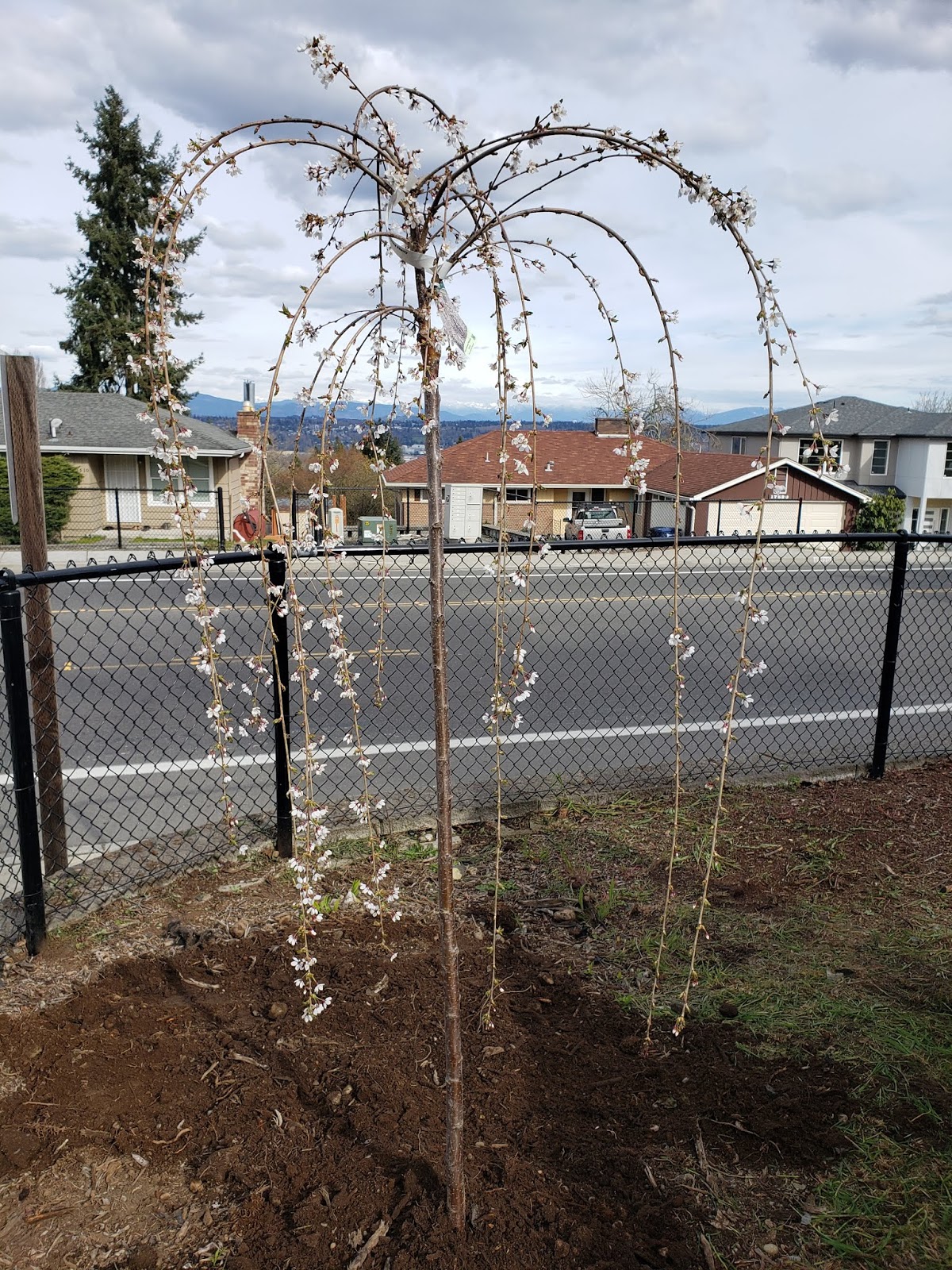
  • Plant a tree or get a houseplant. You can get plants at stores that are otherwise essential, for example grocery stores and hardware stores. Take advantage of spring and get some green in your home.
(new tree brings joy and breathes carbon dioxide)
  • Start a food garden. Whether getting a starter from the garden section of a hardware store, or regrowing food from your produce scraps, growing food has the general benefits of growing plants, and also makes you more food self-sufficient.  
  • Mend clothing. You may have some extra time at home now to catch up on that mending pile. And if you are a beginner, this is the perfect time to practice with worrying so much about the end result. 
  • Gather donations. Just because you can't drop off your donations at a thrift store, doesn't mean you can't gather them in the meantime. For some items like clothing, online sales are a way to deal with donations if you want to move them before physical stores reopen. 
  • Shop produce online. Subscription clubs like Imperfect Produce allow you to get fresh fruits and veggies while avoiding the store crowds. They will now even take back the box they deliver food in. 
  • Switch to a bidet. No better time to consider alternatives than when there's a shortage of toilet paper!
  • Use food scraps to get creative about cooking. Keep small amounts that don't seem like a small serving to combine into an interesting salad or buddha bowl at the end of the week. Keep the trimmings from your veggies to make homemade veggie broth. 
  • Eat your leftovers! If you want to mix things up, just freeze those leftovers, and you'll soon have a stockpile. 
  • Switch to reusable feminine products. With a shortage of those necessary products at stores, no time like now to invest in washable pads, period panties, or a menstrual cup. 
  • Continue to use online marketplaces where safe and available. Some groups like Buy Nothing are reducing posting to essentials only. Find the groups that allow you to buy and sell, read their safety guidelines, and use "porch pick up" for free items.
  • Save your delivery packaging for reuse. Larger boxes are great for moving or storage. Smaller boxes and envelopes for are good for shipping and by small businesses. I put out a weekly stash on the curb and have it claimed each week. 
(boxes with free sign on curb disappear within an hour)
  • Repair something around your home. Now is a perfect time to learn a new skill and prevent the need to shop for new things.
  • Once you've gathered your donations, choose a t-shirt that isn't ideal for donating, and turn it into face cloths/makeup wipes. Simply cut into squares, and you have the softest reusable tissue.
  • Stream more, buy less. Replace impulse buying movies or magazine from the Target end-caps with some of the amazing free content that is being provided by cultural institutions. From museums to Nasa archives, to at-home musical concerts, there is tons of content to enjoy.
  • Pick a favorite snack food and perfect an at home recipe. Love snack applesauce or granola?Identify containers to portion and replace single use snack packs. It will be easier to develop a new routine now than when you are in the hustle of your daily commute. 
  • Use what you have for household essentials or in your pantry. Were you saving staples like condensed soups or cans of beans for a quick dinner? While they may have a long shelf life, it's amazing how often I come across the one that got lost in the back and expired 2 years ago. Rotate your essentials and use them up. 
  • Use what you have for activities or gifts you have yet to get to. Receive a book for Christmas and have yet to crack it open? Get bath and body supplies for your birthday two years ago and haven't used them up yet? While you can't do certain activities that are closed, treat yourself to the things you can do and were planning to "get to someday". 
  • Try a solid bar shampoo or conditioner. It's an ideal time to experiment with new products. Dry products avoid the plastic bottle packaging, and save shipping fuel by concentrating the size and weight of the product. 

What You Can Do When We Return to "Normal":
  • Continue to work from home. Even 1 day per week is a 20% reduction in commuting.
  • Switch to a rideshare or public transit for the days you go to the office. 
  • Keep track of the changes above that were easy for you, and maintain them as we move forward. 

Cheers to you for whatever you're able to contribute amidst this crazy time, and Happy Earth Day. 


Monday, March 30, 2020

Saving a Scratching Post (Easy DIY Repair)

T and I have quite an active kitty, Toby, who just turned 10 this year. He's having a mid-life crisis renewed burst of kitten playfulness, and is going nuts on anything he can scratch. Fortunately, we have scratching posts in several rooms for him to take his energy out on. Unfortunately, they are starting to get destroyed (and look messy) after a few years of abuse. The good news is it's super easy to clean up with just a pair of scissors and some glue. I chose a hot glue gun. You could also use fabric glue or wood glue.

Exhibit A (Before). There is frayed rope on much of the scratching post and a few ropes that are completely ripped loose. 

First, clean up all the loose shreds of twine. I trimmed some of the shreds on the post too, but didn't go nuts because I didn't want to leave it bald!


Next, add a row of glue onto the bald part of the post and press down one of the loose ropes into place. Because these were completely frayed at the ends, I twist or braid them, and continue to glue down until the end is secured. Repeat for each loosened rope.


Exhibit A (After). Not brand new, but way less straggly than when we started. No loose ends or loose shreds of twine.


Exhibit B (Before). This post has the twine barely holding on to the batting ball and the base.


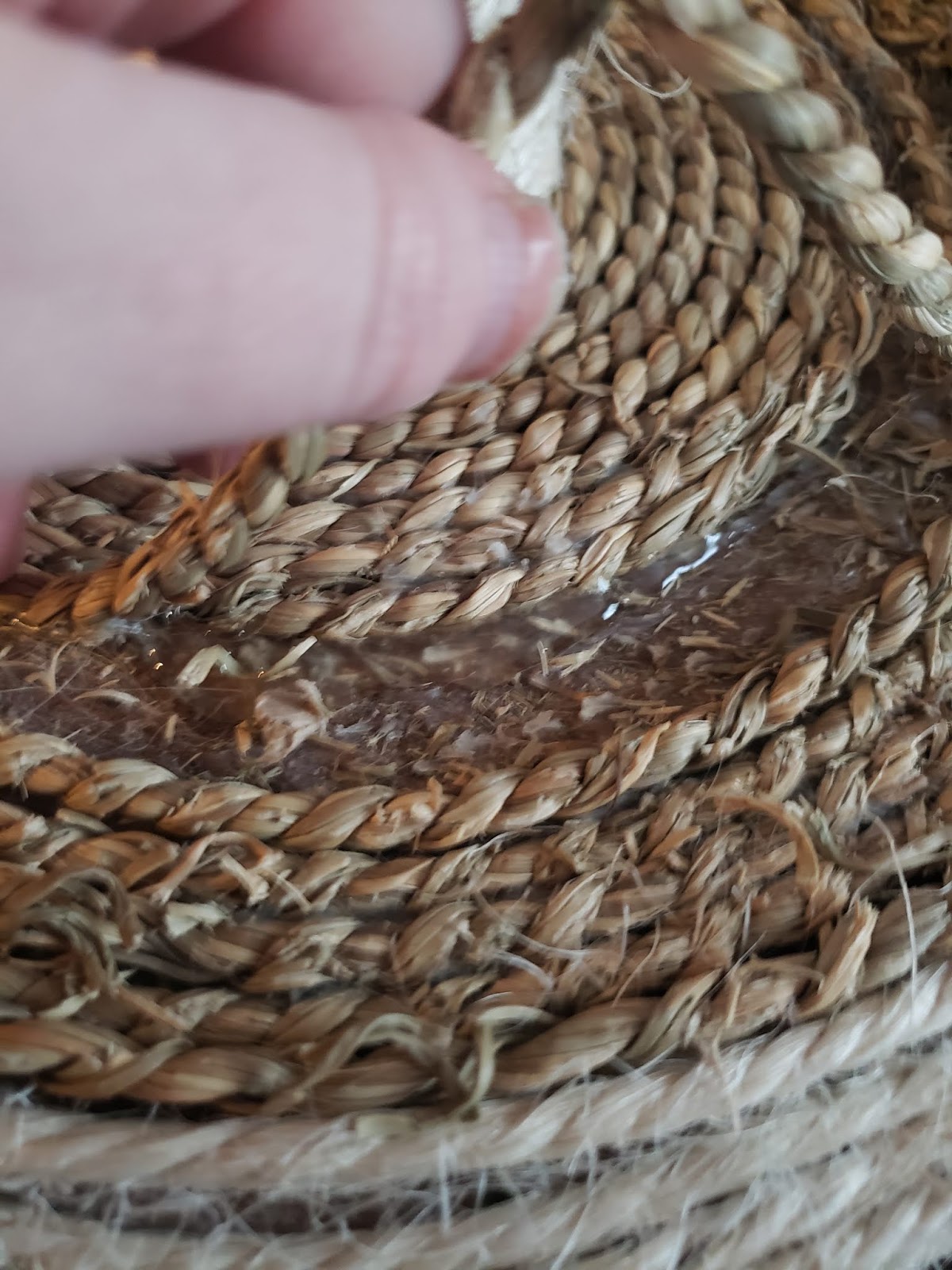
First, I squirt a line of glue onto the base, to secure the rope. I go a few inches at a time, one row at a time, re-winding the rope in the spiral that it was originally. I don't want to go too fast, or my glue will dry before I can get the full spiral laid down.


I repeat with the batting ball, gluing and laying down one row at a time, spiraling around the ball form.


Trim a few loose strands of twine, and viola! Just like new. Exhibit B (After).


Just about 10 minutes of time saved me from replacing worn, ratty toys (at about $20 each), and will give Toby many more hours of scratching time.